Printing history
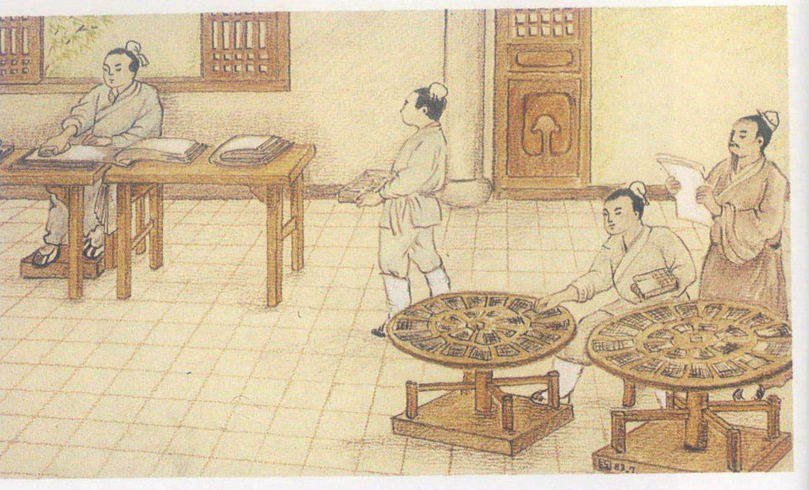


Printing originated in China, originated from the Chinese unique seal culture, it is by the development of stone and seal two methods of gradual development and synthesis, after a very long time, accumulated many people's experience, is the crystallization of human wisdom.
The earliest existing documents and the earliest Chinese engraving printing object were in 600 AD, that is, the early Tang Dynasty.
In the 7th century, engraving printing appeared in the early Tang Dynasty.
Song Renzong Qing calendar years 1041-1049, Bi Sheng invented the clay movable type printing.
This is the earliest recorded moving-type printing in the world.
Yao Shu, a counsellor of Hu Bilie from 1241 to 1250, used movable type to print Zhu Xi's "Primary School", "the Book of recent thoughts" and Lu Zuqian's "Collection of Classical History", which were scattered all over the world.
Yuan Dynasty scientist Wang Zhen-yu 1260-1330) invented the wooden movable type version (also some people support the Song Dynasty on the wooden movable type version, and put forward several versions to prove it.
Among them, what people often mention is "Mao poem", which is called "Song Ben movable script".
Because of the "self" in the first edition of the book "Tang Feng Shan you Pivot", it can be proved that it is a movable type version.
Wang Zhen describes the wooden movable type in the Book of Agriculture: "now there is a convenient method: making plates and wood for printing helmets, cutting bamboo slices for lines, engraving wood for characters, using small saws to cut open, each for a word, with a knife on all sides to match the size of the test, the height of the same."
Then set the line, cut into bamboo clip.
The helmet is full, with the sphene of wood, so that the fastening word does not move.
Then print it with ink. "
Wang Zhen printed 60, 000 characters in 1299 with 100 copies of Jingde County Records.
The early records of the Chinese metal movable type were recorded in the Yuan Dynasty scientist Wang Zhenzhong 1260-1330) in "making movable type calligraphy" (1298): "in modern times, tin was cast as a character, followed by iron bars, doing the line, embedded in the helmet, and in the realm of printing the book, but the above words were difficult to make ink, and the rate of more printing was bad."
So not for long.
The Yuan Dynasty (1271-1368) had two color red and black overprint books.
Yuan Yingzong to two years (1322 years, Fenghua County, Zhejiang Province Yin Ma said de, with 100,000 wooden movable type, typography, "University Yan Yi" 43 volumes 20.
Printed materials that were printed in wood type in the Ming dynasty included "Qing Shui Qun Shi Ying Hui Yuan", "Siyou Zhai Cong said", "Yan Zi Chun Qiu", "Xiao Zi Lu", and "Yan Cheng Ji".
In the Ming Dynasty (1368-1644), there appeared two or four color overprints, which could produce multi-level color printing.
In the middle of the 15th century, John Gudenburg (1397-1468) began to study movable type printing in 1436. In 1440, he was made into a spiral wood-printing machine, and in 1445 he set up a factory to print books.
Until 1477, it spread almost all over Europe and became popular in Europe. It became the origin of modern printing.
In 1589, the western lead type and printing machines were introduced into China, and the Chinese publishing industry began to publish books with lead type printing.
In 1590, the earliest type of book was printed in Western type - "Japanese Envoy to Rome" (Latin), and in 1819 the "Old and New Testament" of the lead type book (Chinese character) was printed in 1838. Into a set of Chinese characters, was in 1842.
Reporting to Hong Kong in 1844, American Yan Xuan set up a Huahua Bible study in Macau.
Utilize the set of lead letters of Tyler to run the business of printing.
In the eleventh year of the Qing Dynasty (1733), Emperor Yongzheng was ordered to make woodcut type letters.
253,500 woodcuts were completed in one year and 2,300 volumes of "Wu Ying Dian Ju Zhen Edition" were printed.
Jin Jian described the procedure for making wood type in the book "Wu Ying Dian Ju Tense Edition".
1845.Germany also produced the first fast printing press.
In 1860, the United States produced the first rotary machines.
In the future, Germany produced two-color quick presses, rotary presses for printing newspapers, and two-color rotary presses. By 1900, six-color rotary presses were made.
From 1845 onwards, after about a century, all industrialized countries have successively realized the mechanization of the printing industry.
In 1859, the Meihua Bookstore was relocated to Shanghai. In the year, the American technician Jiang Beli improved the specifications of Chinese characters and set 37 kinds of standards, laying the foundation for the Chinese character type system.
He also created electroplates and invented the ingot type rack.
He also classifies the Chinese typefaces into common, spare, and rarely used categories, each of which is listed in the "Kangxi Dictionary".
Improve the production efficiency of printed books.
Since then, China began to establish movable type printing institutions, and the printing industry has gradually embarked on a mechanized road.
At the same time, Western lithography has also been introduced to China and has achieved considerable development.
At the end of the century, gravure printing began to be used in China. The form of book products also changed - hardcover and paperback began to appear.






